
Whether your electric golf cart is sputtering up hills, losing range after just a few holes, or failing to hold a charge overnight, battery deterioration leading to replacement is an inevitable milestone of electric vehicle ownership. Planning ahead for major battery maintenance, replacement, or a modern lithium conversion prevents unexpected downtime and keeps your vehicle performing at its peak.
Understanding the expected replacement timeline, component costs, and upgrade options allows you to make an informed financial decision for your personal cruiser or commercial fleet.
At Intermountain Golf Cars, we specialize in battery testing, factory OEM pack replacements, and custom lithium conversions across Utah, Nevada, Idaho, and Arizona. Here is your complete guide to golf cart battery replacement timelines, costs, and installation expectations.
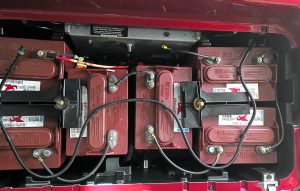
Caption: Professional battery replacement ensures proper cable routing, voltage matching, and long-term electrical safety.
1. When Should You Replace Your Golf Cart Batteries? (The Timeline)
Battery failure rarely happens overnight. Recognizing the early warning signs helps you plan replacement service before getting stranded:
-
3 to 5 Year Mark (Lead-Acid): Standard flooded lead-acid batteries typically require replacement every 3 to 5 years under normal residential or golf course use.
-
8 to 12+ Year Mark (Lithium): Modern Lithium Iron Phosphate (LiFePO4) battery packs endure 3,000 to 5,000+ charge cycles, easily spanning a decade or more of maintenance-free operation.
-
Key Warning Signs:
-
Reduced Range: You can no longer complete 18 holes or a typical neighborhood loop on a single charge.
-
Sluggish Acceleration: The motor feels underpowered when ascending mild inclines.
-
Extended Charging Times: The automatic charger stays active for 10+ hours or fails to turn off.
-
Physical Corrosion or Swelling: Battery cases bulge, leak acid, or develop severe white corrosion around the terminals.
-
2. Golf Cart Battery Replacement Costs Breakdown
Replacement costs vary based on system voltage (36V, 48V, or 72V), battery quantity, and chemistry selection:
A. Flooded Lead-Acid Replacement ($800 – $1,500)
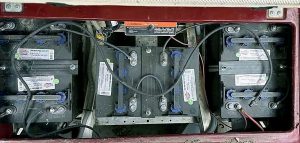
Replacing a standard set of lead-acid batteries (typically 4, 6, or 8 individual 6V, 8V, or 12V batteries) costs between $800 and $1,500 for the battery set. Professional installation, terminal cleanup, disposal fees, and cable inspection generally add $100 to $250.
B. Lithium-Ion Conversion ($1,800 – $3,500+)
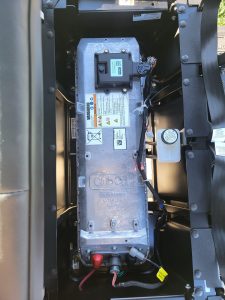
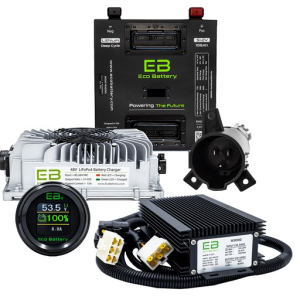
Upgrading from lead-acid to a single high-capacity lithium battery kit ranges from $1,800 to $3,500+ depending on amp-hour rating and voltage. While the initial investment is higher, lithium eliminates recurring replacement costs because a single pack outlasts two to three sets of lead-acid batteries.
3. Quick Comparison: Lead-Acid vs. Lithium Battery Replacement
| Metric / Feature | Flooded Lead-Acid Replacement | Lithium (LiFePO4) Conversion |
| Average Initial Cost | $800 – $1,500 | $1,800 – $3,500+ |
| Lifespan | 3 – 5 Years | 8 – 12+ Years |
| Installation Time | 1 – 2 Hours | 2 – 4 Hours (Includes kit & charger) |
| Weight Impact | Heavy (~300–400 lbs per set) | Lightweight (~100 lbs total) |
| Ongoing Maintenance | Monthly distilled water checks | Zero maintenance required |
| Warranty Coverage | 1 – 2 Years (Prorated) | 5 – 11 Years (Manufacturer) |
Caption: Upgrading to a modern lithium pack reduces vehicle weight by up to 300 lbs and eliminates watering maintenance.
4. What Happens During Professional Battery Replacement?
When you bring your vehicle to a certified dealer for battery replacement or schedule mobile pickup, the installation process includes several critical steps:
-
System & Controller Diagnostics: Testing total system voltage, solenoid response, and speed controller draws.
-
Safe Acid Neutralization & Removal: Safely disconnecting, lifting, and recycling old lead-acid batteries in compliance with environmental standards.
-
Tray Rust Treatment: Neutralizing spilled battery acid and treating steel battery trays to prevent chassis corrosion.
-
Terminal & Cable Upgrade: Inspecting main power wires and replacing corroded 6-gauge or 4-gauge cables.
-
On-Board Charger Calibration: Ensuring the charger algorithm matches the specific battery chemistry (lead-acid vs. lithium profile).
Schedule Your Battery Service with Intermountain Golf Cars
Is your golf cart due for a battery checkup, fresh lead-acid pack, or a game-changing lithium conversion? Maximizing performance begins with trusted service and genuine OEM components from major manufacturers like Club Car and Yamaha.
Ready to Find Your Next Golf Cart or Schedule a Service?
Stop by any of our showrooms or get in touch with our team directly:
-
Locations: Servicing Sandy, Salt Lake County, St. George, Las Vegas, Mesquite, Prescott Valley, Glendale, Chubbuck, and surrounding regions
-
Phone: (801) 255-8828
-
Email: we*******@*******rs.com
-
Website: intermountaingolfcars.com