
The Silent Survivalist: Why a Lithium Utility Cart is Your Ultimate Grid-Down Vehicle
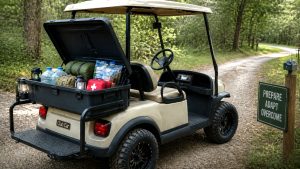
An Industry Strategic Report for Dealership Network Distribution
When the phrase “SHTF” (Shit Hits The Fan) is thrown around in emergency preparedness circles, the mind instantly conjures images of heavily armored, diesel-chugging 4×4 trucks or rugged off-road motorcycles. But in a real-world modern crisis—whether driven by regional conflict, cyber-attacks on supply lines, or catastrophic infrastructure failure—those massive combustion-engine vehicles rapidly transition from assets into multi-ton liabilities.
They are loud, highly visible, and entirely dependent on an complex global supply chain that evaporates the moment a crisis begins. True preparedness requires evaluating transportation through a pragmatic lens of mobility, self-sustainability, and resource independence. When viewed through a strict “Good, Better, Best” framework, the modern utility golf car emerges as an indispensable logistical asset when the traditional grid goes dark.
The Operational Mobility Matrix: Good, Better, Best
To understand the tactical utility of these vehicles, a dealership network must categorize them by their physical capability to navigate a compromised environment.
Good: The Standard Fleet Vehicle
A standard, non-lifted golf car is designed to successfully operate on manicured terrain and golf course roughs. In a localized emergency, a standard unit provides basic, silent neighborhood transportation. It allows for quick perimeter checks, neighborhood communication, and basic point-to-point transit on paved or clear dirt roads. While limited by ground clearance, its inherent simplicity makes it a reliable baseline tool.
Better: The Lifted Off-Road Variant
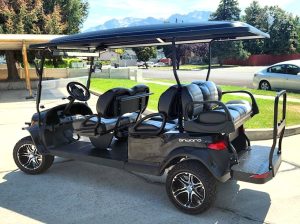
Upgrading to a factory-lifted golf car or utility vehicle equipped with 20-to-23-inch aggressive all-terrain tires dramatically shifts the vehicle’s operational envelope. A lifted cart possesses the unique geometric ability to bypass urban and suburban logjams. It can easily clear standard concrete curbs, navigate around stalled or abandoned automobiles on gridlocked roadways, and traverse muddy fields, washouts, and debris-filled paths that would high-center a standard sedan.
Best: The 4-to-6-Passenger Lifted Utility Box Configuration
The absolute pinnacle of off-grid readiness is a lifted, high-capacity multi-passenger chassis outfitted with a heavy-duty aluminum or composite rear utility cargo box. This configuration functions as a true tactical workhorse. It provides the physical payload capacity to haul vital survival cargo—such as multiple 5-gallon water barrels, firewood, medical supplies, or communication gear—while maintaining the seating capacity to relocate family members safely. It is narrow enough to squeeze through tight pedestrian walkways and light enough to navigate over compromised bridges or terrain where heavy trucks would sink or get trapped.
The Energy and Lubricant Paradigms
The “Good, Better, Best” hierarchy applies even more strictly to the mechanical propulsion systems driving these vehicles.
       [ PROPULSION CAPABILITY MATRIX ]
   BEST   |---> Lithium-Powered Smart Systems (Indefinite Solar Recharging)
  BETTER  |---> Traditional Gas / Lead-Acid Systems (Finite Resource Dependency)
   GOOD   |---> Standard Fossil-Fuel Automobiles (Crippled by Refined Fluid Shortages)
Good: Traditional Internal Combustion and Lead-Acid
Traditional internal combustion engine (ICE) utility carts and standard lead-acid electric carts represent the historical baseline. While functional, they are anchored to finite lifespans. Lead-acid batteries suffer from heavy weight, a shorter overall lifecycle, and a susceptibility to permanent damage if left discharged for extended periods during prolonged power outages. Gas carts provide excellent range but are entirely reliant on a resource that vanishes within days of a major societal disruption.
Better & Best: Factory-Certified or Premium Ugrade Integrated Lithium Systems
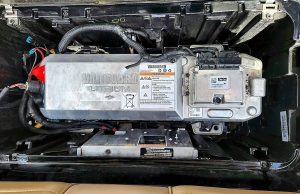
A modern, factory-integrated lithium system (the standard across elite lines from Club Car, Carryall, Denago, etc.) represents the ultimate tier of survival technology.
A premium lithium pack completely removes the user from the vulnerable fuel paradigm. operating on an efficient, stable DC voltage configuration, these smart battery systems are highly compatible with off-grid renewable infrastructure. By pairing the vehicle with a portable folding solar array or a home solar charge controller, the cart can be recharged indefinitely using nothing but the sun. When the grid is completely dark, your transportation remains entirely free, silent, and operational.
Furthermore, a high-capacity lithium pack holds between 5 to 10 kilowatt-hours (kWh) of clean energy monitored by a sophisticated digital Battery Management System (BMS). By adding a dedicated power inverter, the vehicle transforms into a silent, mobile power station capable of running emergency communication arrays, medical equipment, or deep-freezers without emitting the loud acoustic signature or deadly exhaust fumes of a gas generator.
The Overlooked Threat: The Lubricant Chokepoint
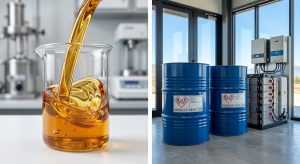
The critical flaw of relying on standard automobiles or gas-powered UTVs in a prolonged crisis extends far beyond empty fuel pumps. Modern geopolitical instability has exposed an even more fragile supply chain vulnerability: the global motor oil supply.
Recent military conflicts in the Middle East and the closure of critical maritime chokepoints like the Strait of Hormuz have choked off nearly half of the world’s supply of Group III base oils—the foundational ingredient required to manufacture high-performance, ultra-low viscosity synthetic motor oils (such as 0W-8, 0W-16, and 0W-20). The independent lubricant market is currently facing unprecedented domestic allocations, with supply levels dropping significantly across major automotive distribution networks.
Major global automakers are already warning that if these refined fluid shortages persist, they may be forced to structurally alter their future engine designs away from the tight-tolerance, low-viscosity oils that modern passenger vehicles require to operate without immediate mechanical failure. In an acute SHTF scenario, finding highly specialized full-synthetic oil to keep a modern automobile running will become virtually impossible.
A lithium-powered utility cart bypasses this entire multi-layered supply failure. It requires zero gasoline, zero specialized internal combustion lubricants, and zero engine oil filters. It strips away the mechanical points of failure that will inevitably paralyze standard cars, trucks, and gas UTVs when the downstream supply chain breaks.
Conclusion: The Ultimate Insurance Policy
True emergency preparedness is dictated by efficiency, reliability, and radical simplicity. When global supply chains fracture and regional infrastructures collapse, the traditional combustion engine rapidly meets its operational limit due to a lack of fuel and specialized lubricants.
By educating the market on the “Good, Better, Best” mobility matrix—and anchoring the conversation to the profound energy and lubricant independence of certified lithium systems—dealerships can frame a premium utility golf car not merely as a seasonal recreational luxury, but as a vital, dual-purpose household insurance policy that keeps families mobile, powered, and protected when the rest of the world goes dark.
The video below tracks the widening ripples of the 2026 Middle East fuel crisis, exploring the exact supply-chain disruptions that are draining Group III base oil allocations and driving the current domestic lubricant shortfalls.
For the best information and selection, including customization, of grid-down golf and utility carts call us at Intermountain Golf Cars (801) 255-8828.
VIDEO: Global Base Oil Shortages and the Automotive Supply Crisis