
Intermountain Golf Cars covers 90-Degree Rule execution, turf protection, and essential cart etiquette.
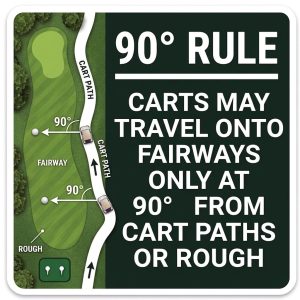
If you’ve ever pulled up to the first tee box and seen a sign that reads “90° Rule in Effect Today,” you might wonder what it means for your round—and your driving.
While it sounds like a geometry lesson, the 90-Degree Rule is one of the most common and important golf cart policies enforced on courses across Utah and nationwide. It strikes a balance between allowing players the convenience of driving to their ball and protecting the golf course turf from excessive wear and tear.
At Intermountain Golf Cars, we not only sell and service top-tier golf carts in Sandy and Northern Utah, but we also help golfers and course managers understand how proper cart operation preserves both turf conditions and vehicle health.
Here is everything you need to know about the 90-Degree Rule, how to execute it correctly, and why courses rely on it.
Caption: A typical 90° Rule sign posted at the tee box, signaling players to minimize driving across fairways.
1. How the 90-Degree Rule Works Step-by-Step
The core principle of the 90-Degree Rule is simple: keep your golf cart on the paved cart path for as long as possible, and drive on the grass only at a right angle (90 degrees) to reach your ball.
Instead of driving diagonally across the fairway directly from the tee to your ball, follow this exact sequence:
-
Drive on the Cart Path: After teeing off, drive your cart strictly down the paved path until you are even with where your ball landed in the fairway or rough.
-
Turn 90 Degrees: Stop the cart on the path, look across the fairway, and make a sharp, 90-degree turn directly toward your ball.
-
Take Your Shot: Drive straight across the turf to your ball, park, select your club, and hit your shot.
-
Return Straight to the Path: Drive directly back along the same perpendicular line to the paved path before advancing down the hole toward your next shot or the green.
Caption: Correct execution of the 90-Degree Rule: driving parallel on the path and taking sharp 90-degree turns to and from your ball.
2. Why Golf Courses Enforce the 90-Degree Rule
Course superintendents enact the 90-Degree Rule for specific maintenance and environmental reasons. Knowing why the rule exists makes it much easier to respect it on the course.
A. Preventing Turf Compaction and Wear Patterns
When dozens of 900-pound golf carts drive diagonally down the center of a fairway all day, they create compacted wear tracks in the grass. Soil compaction starves grass roots of oxygen and water, leading to bare dirt patches, thin turf, and poor playing conditions. By restricting tire contact to short perpendicular crossings, courses reduce total turf stress by up to 70%.
B. Managing Wet Soil After Rain or Irrigation
During damp mornings or following heavy rain, saturated soil is vulnerable to deep tire ruts and mud churning. The 90-Degree Rule keeps heavy vehicles off fragile, wet grass while still granting golfers access to their shots without forcing a total “Cart Path Only” restriction.
C. Protecting High-Traffic Entrance and Exit Zones
Fairways suffer the most damage where carts enter and exit the turf. Adhering to strict 90-degree angles prevents players from creating worn, muddy “highways” along the edges of the fairway.
3. How the 90-Degree Rule Differs from Other Cart Policies
Golf courses adjust cart rules daily based on weather, grass health, and maintenance schedules. Here is how the 90-Degree Rule compares to other standard policies:
Caption: Always keep all four wheels on the pavement when parked near greens and tee boxes.
4. How Proper Driving Protects Your Golf Cart
Following the 90-Degree Rule doesn’t just protect the course—it also prevents unnecessary wear and tear on your vehicle:
-
Saves Battery and Fuel Energy: Driving on smooth, paved cart paths encounters far less rolling resistance than driving through heavy, wet fairway turf or tall rough. This extends battery range per charge on electric models and improves fuel efficiency on gas carts.
-
Reduces Steering and Suspension Stress: Constant turning and bouncing over uneven rough places heavy strain on tie-rods, kingpins, and shock absorbers. Keeping to the path for 80% of the round extends suspension lifespan.
-
Prevents Mud and Debris Buildup: Staying on the path keeps mud, wet grass clippings, and fertilizer chemicals from coating the undercarriage, brake assemblies, and battery terminals.
Keep Your Cart Course-Ready with Intermountain Golf Cars
Whether you operate a personal golf cart for weekend rounds or manage a commercial fleet for a resort or golf facility, maintaining smooth acceleration, tight steering, and responsive braking ensures a great drive every time you hit the fairway.
At Intermountain Golf Cars, we provide expert multi-point servicing, lithium battery upgrades, custom wheel alignments, and routine maintenance for Club Car, EZ-GO, and Yamaha models across Utah.
Need your cart serviced or looking to upgrade to a smooth-riding new or pre-owned model?
Visit our showroom in Sandy, Utah, or browse our online inventory today at IntermountainGolfCars.com.
EMAIL: we*******@*******rs.com
PHONE: (801) 255-8828