
The Lithium Time Bomb: How Repurposed EV Batteries Are Quietly Entering the Golf Cart Market
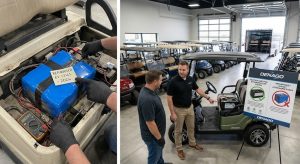
Across North America, a largely unnoticed but serious threat is making its way into golf cart dealerships, service departments, and showroom floors. As demand for lithium-powered golf carts continues to surge, a parallel market has emerged—one that is largely unregulated and potentially dangerous.
This issue is not tied to major manufacturers like Club Car, Yamaha, EZ-GO, or Denago. Instead, it stems from a growing wave of aftermarket lithium conversions and “refurbished” battery packs built from salvaged electric vehicle (EV) components. These batteries are often marketed as affordable upgrade solutions, but behind the lower price point lies a significant safety risk.
Recent investigations have uncovered international supply chains that extract lithium-ion cells from damaged or retired EVs, including Teslas and Nissan Leafs. These cells—often degraded, mismatched, or previously compromised—are reassembled in uncertified facilities. They are then repackaged into generic battery cases and sold through online marketplaces, direct dealer channels, and bulk wholesale offers.
A recent deep-dive investigation published by The Epoch Times exposed a massive international network pulling spent, degraded lithium battery packs out of salvaged, wrecked, or aged automotive electric vehicles (EVs) like Teslas and Nissan Leafs. These high-voltage automotive packs are systematically chopped open in uncertified warehouses, their internal cells scraped of corrosion, re-soldered by hand, and stuffed into generic plastic cases.
For dealerships handling high trade-in volume and multiple locations, these batteries represent more than just a quality issue. They pose a direct threat to property, safety, and liability.
Why These Batteries Are Dangerous
To understand the risk, it helps to compare lithium-ion batteries with traditional lead-acid systems.
Lead-acid batteries are relatively forgiving. When they fail, performance drops—carts slow down or stop charging—but the failure is typically contained and non-violent.
Lithium-ion batteries behave very differently. A properly engineered lithium battery contains multiple cells that are carefully matched for age, capacity, and internal resistance. These cells are managed by a sophisticated Battery Management System (BMS), which regulates temperature, charging, and performance in real time.
In contrast, repurposed battery packs often combine cells with vastly different histories. One cell may have endured years of fast charging, while another may have been exposed to water damage or extreme temperatures. When these mismatched cells operate together under load—such as climbing a hill or carrying multiple passengers—instability can occur.
If one cell overheats, it can trigger a chain reaction known as thermal runaway.
From Malfunction to Fire
Thermal runaway is a rapid, self-sustaining reaction where a battery cell overheats and ignites neighboring cells. Unlike traditional fires, lithium-ion fires generate their own oxygen, making them extremely difficult to extinguish. Standard fire extinguishers are largely ineffective.
These fires burn at extremely high temperatures and release toxic gases. In a confined environment like a showroom or service bay, the consequences can be catastrophic.
A single compromised battery has the potential to ignite nearby carts, leading to a chain reaction that can destroy an entire inventory within minutes.
A Real-World Warning

Firefighters against lithium-ion blazing golf carts. Credit: Ayuntamiento de Marbella
This is not a theoretical risk. In 2023, a major fire broke out at the renowned Guadalmina golf course near Marbella, Spain. The blaze spread rapidly through a fleet of lithium-powered golf carts, destroying approximately 100 units and causing extensive property damage.
The total losses exceeded $1 million.
The key takeaway is simple: when lithium batteries fail in close proximity, the damage scales very rapidly. What begins as a single battery failure can quickly escalate into a full-scale facility loss.
The Dealership Risk
For multi-location dealerships, the danger is amplified by operational realities.
Trade-ins are often accepted quickly, with sales teams focused on closing deals rather than performing deep technical inspections. A customer may present a relatively new cart and highlight a recent “lithium upgrade,” making the vehicle appear more valuable.
Moreover, although low-priced, off-market lithium batteries may seem tempting, buying no-name products from questionable sources can involve considerable risk. So, if such an upgrade involved a low-cost, unbranded battery pack purchased online, a dealership may unknowingly introduce a high-risk unit into its inventory.
These batteries typically lack documentation, traceability, and verified safety testing. There is no reliable way to determine their condition or remaining lifespan. In effect, the dealership inherits a hidden liability.
Key Differences in Battery Quality
The gap between certified and repurposed batteries is significant:
- Certified systems use new, traceable cells with verified performance data.
- Aftermarket packs often use salvaged or rejected cells with unknown histories.
- Factory systems include advanced BMS technology with safety cutoffs.
- Low-cost packs may rely on minimal or poorly designed circuitry.
- Certified batteries meet strict safety standards such as UL certification.
- Repurposed packs often bypass testing entirely.
- This difference directly impacts both safety and legal exposure.
Regulatory and Legal Implications
In the United States, standards like UL 1974 were created specifically to address the risks associated with repurposed batteries. Achieving compliance requires rigorous testing, documentation, and quality control—something most low-cost battery suppliers do not pursue.
Additionally, OSHA regulations require specialized training and safety procedures when handling lithium-ion batteries above certain voltage thresholds. If dealership staff handle or charge uncertified batteries without proper safeguards, the business could face serious regulatory penalties in addition to property loss.
How Dealerships Can Protect Themselves
Given the scale of the risk, informal inspections are no longer sufficient. Dealerships should implement strict, standardized protocols across all locations:
Establish a “No-Name, No-Entry” policy. Reject any trade-in with an unbranded or uncertified lithium battery lacking clear labeling and serial identification.
Require physical verification. Service teams should inspect battery compartments and confirm manufacturer details before any work or charging begins.
Isolate high-risk units. Any cart with an aftermarket lithium system should be stored outside and away from primary inventory until fully vetted.
These steps may slow intake slightly, but they significantly reduce exposure to catastrophic loss.
Turning Risk Into Opportunity
While this issue presents a serious challenge, it also creates a strategic advantage for informed dealerships.
Sales teams can use this knowledge to educate customers. When buyers question the higher cost of factory-installed lithium systems, staff can clearly demonstrate the difference between certified, engineered solutions and unverified aftermarket alternatives.
Showing the physical and technical distinctions—such as build quality, safety features, and warranty backing—helps shift the conversation away from price alone. It reframes the purchase decision around safety, reliability, and long-term value.
In a market increasingly crowded with low-cost options, trust and transparency become powerful differentiators.
Paul Jensen, Intermountain Golf Cars